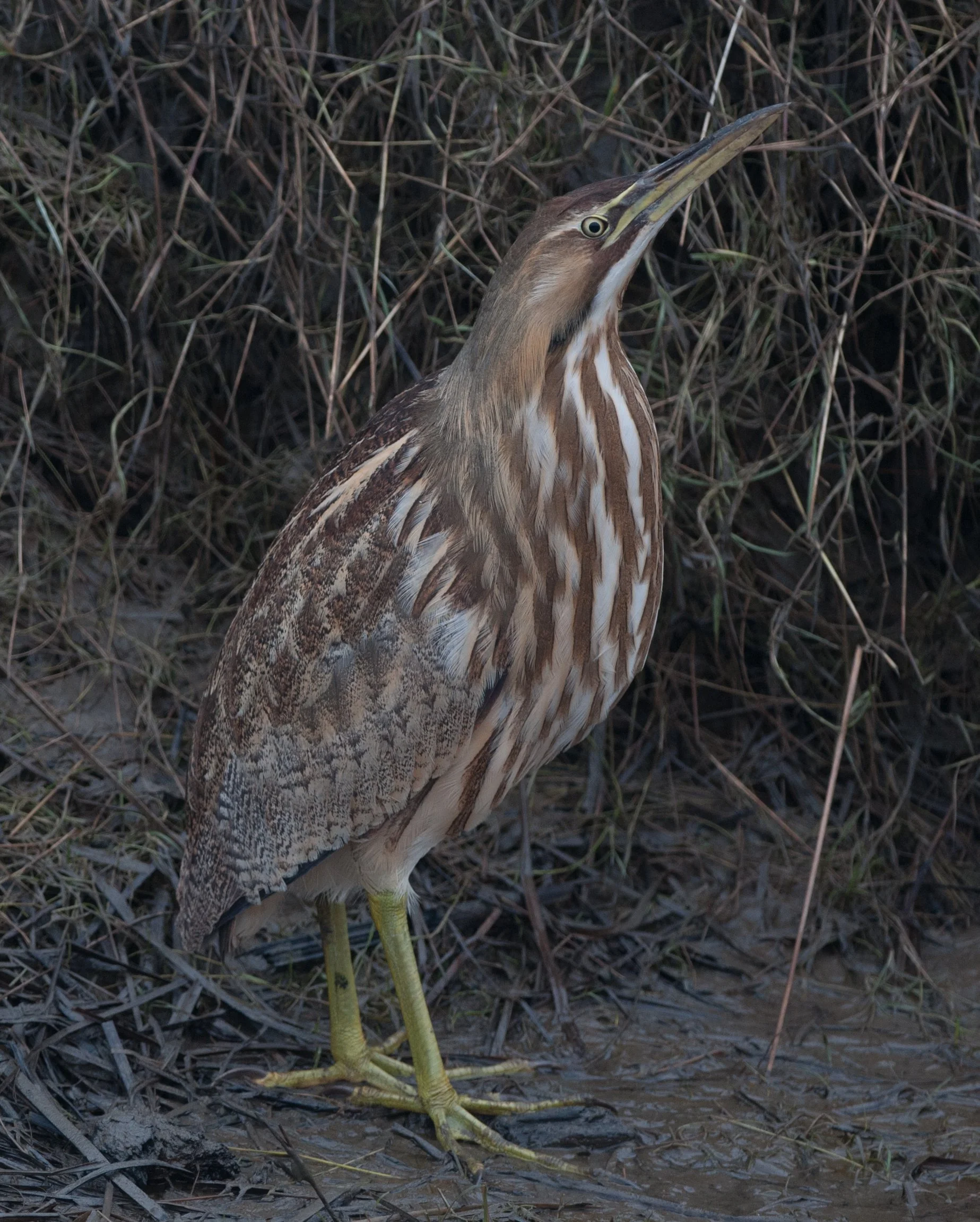
Protecting American Bitterns at Northern State Recreation Area
Skagit birders know that the best place to hear and see American Bitterns is just east of Sedro-Woolley at the Northern State Recreation Area (NSRA) wetland along State Route 20. Puget Sound Bird Observatory volunteers doing the Wetland Secretive Bird Survey readily detect bitterns there and all but one of the survey’s other target species. Six years ago, daily walkers at NSRA alerted Skagit Audubon to multiple bittern pairs likely nesting in the field between the wetland levee and Helmick Road. In 2019 there were credible reports of mowing destroying bittern nests in the field. The following year Skagit Audubon attempted to more specifically document bitterns’ presence and use. We estimated 2 or 3 pairs were nesting in the tall grass, and we provided County Parks with a map suggesting an area to be left unmown. Over the opposition of people who considered the uncut field unsightly and of others who preferred baseball diamonds there, County Parks Director Brian Adams left most of the field unmown. Early last month, Brian retired.
“In 1991, Skagit County purchased a 726-acre portion of the former Northern State Hospital from the State of Washington for the purpose of developing a major regional recreation facility for the citizens of Skagit County and beyond” (Master Plan 9-27-02.doc). This county park encompasses what had been the farm raising food for Northern State Hospital and other state mental health institutions. In 2002 a large group of stakeholders convened to develop a master plan for Northern State Recreation Area. The plan called for constructing 5 baseball diamonds in the field off Helmick Road near the park’s main access (Map: Master Plan 9-27-02.doc). It also called for de-channelizing Hansen Creek just west of the field and constructing a dike to keep the creek’s multiple new channels away from the planned ballfields. The Upper Skagit Indian Tribe’s Natural Resources Department accomplished the creek restoration project in 2010, including planting thousands of trees and shrubs. Hansen Creek reoccupied its flood plain to the benefit of salmon and many other species. Beavers arrived and soon expanded the wetland creating excellent habitat for bitterns, rails, ducks, herons, marsh wrens, and more.
Skagit County Parks lacked funding to build the planned ballfields on Helmick field, and bitterns eventually found the unmown field to be fine nesting habitat adjacent to their foraging marsh. In addition to the diverse birds, this multi-use public park has many human stakeholders. How different segments of the public want to use the park shifts with time. For some people NSRA offers great hiking or a place for daily dog-walking, a wildly popular disc golf course or a cross-country track route - - and a good spot for observing diverse birdlife. At this time of year there are people who go to NSRA every evening to listen and watch for the Helmick field bitterns.
Now the City of Sedro-Woolley is proposing an agreement with the county to build four Little League ballfields on the Helmick field to replace ones severely damaged at the city’s Riverfront Park every time the Skagit floods. The proposal also calls for additional parking. During the Skagit County Parks & Recreation Advisory Board’s April 16th meeting, Sedro-Woolley’s Parks & Facilities Director presented the city’s proposal with the new mayor sitting nearby. After I described the importance of Helmick field for nesting bitterns, another parks board member joined me in proposing alternate nearby locations for the four ballfields that would avoid disturbing the bitterns. The proposed parking expansion is close to Helmick Road and away from the area the bitterns use.
Sedro-Woolley’s landscape architect will map these alternatives, and the city’s representative will come back to the parks board. In the meanwhile, Skagit Audubon will update our understanding of bitterns’ current use of the Helmick field. It is timely now for Audubon members and friends who want to see the field continue to be available for nesting bitterns to write the City of Sedro-Woolley. Address letters to Parks and Facilities Director, 325 Metcalf Street, Sedro-Woolley, WA 98284 with a copy to Mayor JoEllen Kesti, 694 Brickyard Boulevard, Sedro-Woolley, WA 98284.
Roadless Rule
The September and October 2025 issues of Skagit Audubon Conservation Notes discuss this federal rule established 25 years ago which the federal administration is in the process of rescinding (Sept25ConservationNotesUpdated083025.pdf and Oct25ConservationNotes.pdf). The Roadless Rule exempts 58 million acres of roadless and unlogged U.S. Forest Service lands from clearcutting and road building, including almost 2 million acres in Washington. If the administration honors the requirement to solicit public comment, the draft Environmental Impact Statement for rescinding the rule should have appeared by the time you’re reading this. If we are allowed comment, please do so when you find or are sent instructions. These public lands belong to us all. They are vital habitat for a myriad of birds and other creatures and also provide recreational experiences in nature for millions of people.
State Wildlife Action Plan (SWAP)
In April the US Fish and Wildlife Service approved Washington Department of Fish & Wildlife’s (WDFW) ten-year update of the State Wildlife Action Plan. Last year we had the opportunity to review and comment on the draft. The plan analyzes which wildlife species (and now also plants) are or may be in decline in Washington and describes actions to stem their decline and avoid the much greater expense of recovering species near extinction. The plan makes Washington eligible for federal grants to help with implementation. The updated SWAP should appear on WDFW’s website in May: State Wildlife Action Plan (SWAP) | Washington Department of Fish & Wildlife.
For more information about conservation issues Skagit Audubon is tracking, go to Conservation notes & letters — Skagit Audubon Society. Audubon members can advocate for regional and national protection of birds and other wildlife and their habitat by responding to action alerts from Washington Audubon and National Audubon. Enroll in Audubon Washington’s Action Network at Join Our Action Network | Audubon Washington. The National Audubon website (Advocacy & Action | Audubon) has abundant information on Audubon’s current conservation campaigns. Sign up to receive national alerts (Join Our Action Network | Audubon).